Tuesday, January 12, 2010

The Disarray of Louisiana Justice


Legislative action needed.
Gosserand|Ricky Ward,Parker,La.AG|Kevin MacDonald-DA| MADD-Louisiana
|2thead-Victoria Jean Gosserand| D'Aguila-Rose Parker-Donna Tate| Family asks DA to recuse himself|Pointe Coupee Victims Assistance Will Justice Prevail in New Roads, La.

The disarray of justice in Louisiana, has now manifested itself in a physical form. Its affects have in effect placed the judicial process in further jeopardy. Not only has Jelpi Picou, formerly with the Capital Appeals Project; siphoned at least $100k from a state-funded program, the Legislature has still not convened any committee(s); joint or sub, to research or gain needed information on the current debacling circumstances.

To begin with, increasing the public's confidence in the system; which, in turn would aid in decreasing the 2009 spike in crime in some areas. Recent events of youth violence is approaching epidemic. Citizens in one NE La. Legislative district are preparing a citizen optioned covert operated response to end the spike.

All the while, in federal court a state legislator's brother began trial on Hobbs Act violations. Although, no one has been nominated yet, the US Atty for the same district has tendered his resignation,effective on MLK day. A US Supreme Court decision is holding back a trial of the same individual on other charges in which a DA is also involved.

Not to mention, the state AG has taken on a 2009 police killing in Claiborne parish, for which no dates have been set. A Jan 2009 taser-death "stun-drive" case is scheduled to begin February 9th 2010 in a rural parish. In July '09 a Colfax man was killed by police. And the Calcasieu parish public defender system is back in court for a repeat. But now with, the recent upheavels in the 19th JDC-PDO and the recent revelations of case fixings for pay, it should be evident the system needs a thorough going over.

Does any body really care.
The current United States Attorney General was involved in a wrongful conviction case at the time he was nominated by the POTUS. That case, subsequently settled with the exoneree receiving millions. But there are others, who are trapped in this jurisprudence gone awry. Beyond the personal objectives and agendas, there is still opportunity to begin the real work of evolving into a better position. There is no giving up in this fight. All the signs are there to let the sighted know, what must be done. As citizens. May the parties in position respond to this appeal.

In a 2008 resolution, the Louisiana Legislature's LLBC was requested to convene hearings on the justice apparatus in the state. The then chairman of the LLBC agreed. A house concurrent study resolution was authorized, and nothing has come to fruition. 2010 is here. Yet it is not too late, to do the right thing. Although, there is a new chairwoman, who will take this endeavor on?

Someone has to make a move! It has to happen, now. Are you the one?

Sunday, October 25, 2009

Justears! Louisiana Backwater

Injunctive Relief Needed in present court systems | Failed Justice | Louisiana Appellate Project | '08 La. Legis. House Concurrent Study Resolution [HCSR-1] approved - no action taken

[ JP resigns] Several accounts
have been made relating to a justice of the peace in south Louisiana. Some who retold the story state the JP denied a marriage license to the couple. Not true.

The state official refused to perform the ceremony. The two individuals have now filed suit for civil rights violations in the federal courts. Great.

This could be a perfect storm to make the state's highest court do it's job. In forcing the high court to act, it could very well alter the face of the system, finally. The new chief justice, has a few things to prove in her role. The civil rights suit has nothing to do with actions of the judiciary commission. The commission, is already however wanting to get around it's efficacy. A spokesperson from the judicial administrators office told a national news outlet, the process could take as much as a year. However, the chairman of the commission can cause the body to act, sooner than later if it so desires.

The commission's legal counsel, should already have begun compiling her information to present to the commission, on how the JP's defense may seek to defend him. Truly, the inner workings of the process is hard to unravel. Within the process, the commission's legal counsel will advise the commission on the possible routes the JP's defense may take. The office of disciplinary counsel will make the formal accusatory declaration to the JP. That person is the interim special counsel.

The former special counsel left the commission last year. In 1994, he went to work for the judiciary commission where his primary responsibility was to investigate complaints against judges and hand recommendations for discipline to the commission, a panel of three citizens, three judges and three lawyers appointed by the state Supreme Court. Once the commission settles on a sanction, it's the special counsel's job to persuade the justices to adopt the recommendation.

If, in the function of his office, a state official violates the law it is malfeasance. If, under the color of law an official violates the law and denies a person civil rights the public integrity section of the justice department can pursue criminal charges.

The Public Integrity Section oversees the federal effort to combat corruption through the prosecution of elected and appointed public officials at all levels of government. The Section has exclusive jurisdiction over allegations of criminal misconduct on the part of federal judges and also monitors the investigation and prosecution of election and conflict of interest crimes. Section attorneys prosecute selected cases against federal, state, and local officials, and are available as a source of advice and expertise to other prosecutors and investigators. Since 1978, the Section has supervised the administration of the Independent Counsel provisions of the Ethics in Government Act.

And what if prior state attorney's general were indeed aware of a JP's violative interpretation of their elected office? Who is now liable? The State? Is the state in need of expertise and advice from federal sources? Recusals of local US Attorneys are also a part of the public integrity sections operation. Would the state supreme court be found deficient? Would other areas of the state's judicial apparatus be subject to purview? Perhaps.

On, another note; the state's director of indigent defense, functioning under Act 307 passed by the 2007 regular session has admitted to media the system is broken. The Judiciary has the role of making sure proper judicial process is carried forth. Indigent defendants are routinely wrongly convicted through ineffective assistance of counsel. Is it unimaginable, the mere refusal to honor an officially obtained license from a clerk of court could evolve in to a full scale re-aligning of the system?

The Special Litigation Section of the Civil Rights Division of the US Department of Justice, recently finished an investigation into the Orleans Parish Prison. Released 9-11-09 it outlined deficiencies with the facilities operation. The final paragraph says in part - "We are obligated to advise you that, in the event that we are unable to reach a resolution regarding our concerns, the Attorney General may initiate a lawsuit pursuant to CRlP A to correct deficiencies of the kind identified in this letter"... .. .. .. . . .

Thursday, July 30, 2009

Memphis to Massachusetts

It is Not a time to be silent! America is a Police-State. Martin|Memphis|& Profiling. If you think the system is not edged against us. Consider this, who is next? Police investigating officer-involved shooting
July 25, 2009

The Louisiana State Police Bureau of Investigations/Alexandria Field Office is investigating a Friday shooting in which a Colfax Police officer fatally shot a man.

The shooting happened around 2:45 p.m., according to a State Police release. According to that release, Colfax Police Officer Stephen Merchant witnessed a physical altercation between Harold Phillips, 54, of Colfax, and an unidentified person on Chester Street while on patrol. As Merchant approached the two, Phillips fled on foot.

The foot pursuit led Merchant to Ash Street, where a physical altercation occurred between Officer Merchant and Phillips. It was at that time that Merchant shot Phillips, according to the report.

The Colfax Police Department requested that the State Police investigate the incident. The Grant Parish Sheriff's Office is assisting in the investigation.

Phillips was transported to Rapides Regional Medical Center, where he was pronounced dead.

The investigation is ongoing and, at the conclusion, the case will be forwarded to the Grant Parish District Attorney's Office.
The Town Talk


Couple Sues Police Over Dog's Death, Abuse In Raid
Yes, this involves cops threatening children with machine guns
By JIM NEWELL
Updated 6:31 AM EDT, Wed, Jul 29, 2009

The Hendersons' story spread like hotcakes in January 2008 after a Howard County SWAT team entered their Columbia home, late at night, brandishing a warrant for a major drug-dealing operation -- for some other home down the street: "a nearby house the police raided later that evening more closely matched the warrant’s description, and contained marijuana, a pair of scales and large sums of money." All they found drug-wise in the Hendersons' home was some pot and a bowl belonging to their house guest, who was immediately arrested for possession. Couple Sues

Officers involved in fatal La. shooting resign
(AP) – 1 day ago

HOMER, La. — Two white police officers involved in the fatal shooting of a 73-year-old black man in northern Louisiana have resigned from the force.

The Feb. 20 shooting of Bernard Monroe Sr. sparked protests and at least two investigations.

Officer Tim Cox, who shot Monroe in his yard, and Officer Joey Henry, who was present at the time of the shooting, have decided to pursue other employment, said Homer city attorney Jim Colvin.

"Tim Cox told me he is moving to St. Tammany Parish and I think will be training canines for police departments," Colvin said. "I don't know what Joey Henry is going to do."

Both officers had been on paid administrative leave after the shooting, which is still under investigation by the FBI and state police.

"They should have been gone," said Rev. Willie Young, head of the Claiborne Parish NAACP, on Wednesday. "I don't think taxpayers should have been paying their salaries all this time."

Monroe, who was mute after losing his larynx to cancer, was cooking on a grill in his yard with relatives and friends when the police officers arrived. In a report to state authorities, Homer police said Cox and Henry chased Monroe's 38-year-old son, Shaun, from a suspected drug deal blocks away to his father's house.

Witnesses disputed that account, saying the younger Monroe was talking to his sister-in-law in a truck outside the house when officers arrived.

There was a scuffle between the officers and Shaun, in which Shaun was shocked with a Taser. Police said the elder Monroe then pulled a gun on them and Cox fired his weapon. Witnesses claim Bernard Monroe was unarmed as he walked toward his porch.

State police said in February that a loaded gun was found on or near Monroe's body. But friends and relatives suggested police planted a gun Monroe owned next to his body.

The American Civil Liberties Union of Louisiana is studying arrests and traffic citations by Homer police as part of an investigation of racial profiling complaints against the department.

Reached by phone on Wednesday, Police Chief Russell Mills refused to comment.

Copyright © 2009 The Associated Press. All rights reserved.

Tuesday, May 26, 2009

Supreme Court & Indigent Defense - Louisiana Spotlight

| Obama Speaks to 100 year NAACP July 16, 2009 | Video-Obama@NAACP | Gates!-Profiled? | Barbara Boxer-Racial? | Is the NAACP Relevant-Clarence Page | Gates charges dropped | WaPo Story |

| LOUISIANA STANDARDS ON INDIGENT DEFENSE | News.doc LSBA new [model] ABA Rules on Professional Conduct |
Splitting 5-4, the Supreme Court on Tuesday overruled its 23-year-old ruling in Michigan v. Jackson on the rights of a criminal suspect in police custody who has asked for a lawyer. The Court did so in Montejo v. Louisiana (07-1529), in an opinion written by Justice Antonin Scalia. After Scalia announced the decision, Justice John Paul Stevens spoke orally for the dissenters — a somewhat unusual gesture. Stevens was the author of the 1986 decision that was cast aside; he was the only member of the Court then who is still sitting. Michigan v. Jackson overrulled in Montejo v. Louisiana
Sotomayor
Louisiana Public Defender Board Staff. The Spotlight is steadily glaring on the state of Louisiana. Within the boundaries of today's SCOTUS decision is a blatant 5 to 4 conservative response in answer to an already vulgar criminal justice apparatus in Louisiana & America.

Brief of AMICI CURIAE the Louisiana Public Defenders Association in Support of Petitioner JESSE JAY MONTEJO V. STATE OF LOUISIANA - rendered 26 May 2009.

The Sixth Amendment provides a right to counsel at each “critical stage” of a criminal proceeding. This case addresses whether a defendant must affirmatively accept the appointment of counsel to receive the protections of that right, particularly the protection not to be interrogated by the state without counsel’s presence or consent.


INDIGENT DEFENSE IN NORTHEAST LOUISIANA Both expenditures and revenues for the 4th Judicial District have increased over
the years under study. Because the data collected in the previous study is in a
different format than the data collected for the last two years, the individual line
items are not directly comparable; instead, focus should be placed on the total
revenues and expenditures when making comparisons. In addition, the 2003 and
2004 totals represent 11 month totals (January through November); the 2006
figures are full-year totals. The 4th Judicial District is unique among the four under study here as it is the only Judicial District that has a formalized on-going training program for public defenders who handle felony cases.

This training occurs monthly and is open to
all public defenders from other Judicial Districts. The 4th Judicial District is also
working to prepare a training manual that can be easily distributed, as well as
expanding the training program to include public defenders who handle
misdemeanor cases and one for those how handle juvenile cases. These
subsequent training courses will also be open to all public defenders from other
judicial districts.

Effective August 15, 2007, the Louisiana State Legislature enacted a new law (R.S.
15:146-184) revising the Louisiana Indigent Defense Assistance Board (LIDAB)
and creating the new Louisiana Public Defender Board (LPDB). This new law
provides that the LPDB shall have “all regulatory authority, control, supervision,
and jurisdiction, including auditing and enforcement, and all power incidental or
necessary to such regulatory authority, control, supervision, and jurisdiction
over all aspects of the delivery of public defender services throughout the courts
of the state of Louisiana” (R.S. 15:147). What was known as “indigent” defense
has since become “public” defense. The adage “the name has changed but the
game remains the same” certainly applies.

Indigent Defense Services Task Force

Louisiana Public Defenders Association

NACDL Indigent Defense Recent Developments In the spring of 2003, the Louisiana State Bar Association passed a resolution in honor of the 40th anniversary of the Gideon decision that called into question the adequacy of adult indigent defense services in Louisiana and urged the state government to establish a “Blue Ribbon Commission to develop a strategic plan for indigent defense system reform and set a timetable for implementation.”

LASC Rule XXXI (3) Private Practice of Law. A staff attorney of a district indigent defender board, who is a permanent, full-time employee of the district board, shall not engage in the private practice of criminal law in the same jurisdiction in which he or she serves as a staff attorney. The said attorney, however, may be permitted by the district board to have a private civil law practice in the same jurisdiction in which he or she serves as a staff attorney, provided such practice does not conflict with or otherwise adversely affect the duties owed by the attorney to his or her indigent clients.

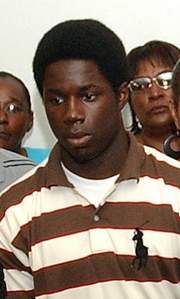
What's the matter with this picture? Already the "wheel of justice" rolled when the news article showed the "leading" photograph of this 19 year old accused suspect, as he was being transported to OCC.
The 40 something year old trigger-man is the real culprit. Video surveillance doesn't show the 19year old in the store. The 19 year old doesn't admit to knowledge of the crime, before leaving Morehouse Parish.
Will the Indigent Defense system of the 4th Judicial District provide adequate assistance of counsel.

IN DEFENSE OF PUBLIC ACCESS TO JUSTICE
To recognize the 40th anniversary of the Supreme Court's decision in Gideon v. Wainwright, 372 U.S. 335, 83 S.Ct. 792, 9 L.Ed. 2d 799 (1963), and to rededicate the State of Louisiana to the promise of equal justice for all, regardless of income, in accordance with the American Bar Association’s (ABA) Ten Principles of a Public Defense Delivery System, by creating the Louisiana Task Force on Indigent Defense Services.
WHEREAS, 2003 marks the 40th anniversary of the Supreme Court's decision in Gideon.. .

WHEREAS, the Supreme Court stated in Gideon the "obvious truth" that "in our adversary
system of criminal justice, any person haled into court, who is too poor to hire a lawyer,
cannot be assured a fair trial unless counsel is provided for him"; and
WHEREAS, the Supreme Court has consistently extended the right to counsel to critical
stages of criminal proceedings and any case that may result in the potential loss of liberty,
including: direct appeals -- Douglas v. California, 372 U.S. 353 (1963); custodial
interrogations -- Miranda v. Arizona, 384 U.S. 436 (1966); juvenile proceedings resulting in
confinement -- In Re Gault, 387 U.S. 1 (1967); preliminary hearings -- Coleman v. Alabama,
399 U.S. 1 (1970); Louisiana Justice Coalition

Friday, April 3, 2009

Obama:European Capitalist Venture

NATO Host Cities protest rallies.

STRASBOURG, France — President Barack Obama laid down a tough new line on America and Europe Friday morning, saying both were to blame what he called the "drift" in the trans-Atlantic alliance in recent years.

"In America, there's a failure to appreciate Europe's leading role in the world," Obama said, boldly taking aim at the country that just elected him last November. "There have been times where America's showed arrogance and been dismissive, even derisive."

Of Europe, Obama looked directly at a few thousand German and French students in a town hall in Strasbourg, France, and told them that the continent had showed "an anti-Americanism that is at once casual but can also be insidious."

"There have been times when Europeans chose to blame Americans for much of what is bad," he said to a crowd that had been elated at Obama's entry but then turned silent after his remark.

"So," he continued, "I've come to Europe to renew our parternship."

The tone of Obama's rhetoric changes in Prague!

Nuclear Disarmament


Before Turkish Parliament


Turkish News - Hurriyet

Wednesday, December 31, 2008

In the Final Throes

Seated


April 15, 2009 - Anarchy & they don't even Know It!
Knoxville, Tenn April 15, 2009 - The Original Knights of the KKK were established in Jackson, Tennessee. They are requiring all military, veterans, law officers & those who took the oath to "protect & serve", "to defend the Constitution of the United States of America", "against enemies foreign & domestic" to stand against the policies of this present GOVERNMENT. This will no doubt bring about violence-these are fighting words. Boehner of Ohio & Cornyn of Texas are the main proponents of this coup attempt. Cornyn wore his Texas Lawman hat on Inauguration Day & Boehner had the subversive glare.

Oath Keepers aka Tea Party
------------
Crawford, Tx.,Iconocast[lonestaricon.com]Current Issue-Oath Keepers
------------
Seattle Action Network LibertyBelle w/Rick Santelli
------------
The Chicago Tea Party
------------

Now, the signification is, we're in the final throes. Don't believe it? God, forbid if something would happen to 44.
Re Oathed?!----------------------------------------------------------------
January 21, 2009, 7:53 pm
Oath Is Administered Once Again
By Jeff Zeleny
WASHINGTON – President Obama was re-administered the oath of office on Wednesday evening by Chief Justice John G. Roberts Jr., one day after the two men stumbled over each other’s words during the inauguration.

Mr. Obama and Mr. Roberts stood in the Map Room of the White House at 7:35 p.m. and recited the oath before a small group of advisers and a handful of reporters.

Robert Gibbs, a spokesman for the White House, said the oath was re-administered out of an “abundance of caution” because a couple of words were out of place on Tuesday. The White House Counsel’s office thought the original oath was proper, Mr. Gibbs said, but Mr. Obama did a second oath anyway.

------------------------------------------------------------------------------------

The final painful struggle out of the past, into the "New Day" is signified in the current media frenzy about "the defendant left hanging" in the noose incident of 2007 that some say spark a new civil rights era.

Now some want to say, the proverbial - see there, I told you. What occured on that dawn of autumn day concerned the travesty of a weighted system. The indivduals, were themselves, mere "vehicles" to cause to occur, what must.

But, we find our selves in the final throes. A painful struggle is in process. It is only the beginning.

The organisms of disorganization, should be prepared to experience chaos.

Re Oathed?!

Saturday 11July09

Ghana Slave Port tour


Obama Recounts African Roots

Tuesday, November 4, 2008

Go Back To Jena!


--UNEQUAL JUSTICE REIGNS STILL!!

--Guantanamo On the Bayou!!


Melissa Bell Held by Jena Justice System!!! $100,000.00 Bond. "When saw we thee in Prison" It's Still UNEQUAL JUSTICE in Jena, Louisiana in 2008!!

Mauffray to retire from the Bench in December! - His brand of UNEQUAL JUSTICE will remain in force.

Jindal Visits Jena!! - Introduced at church service by Reed Walters.


Bush Visits Alexandria just prior to killings!!!

Black Mother & two (2) daughters run over & KILLED IN ALEXANDRIA, LOUISIANA. Driver of Vehicle had history of DUI's & other vehicular related incidents!!! FREE ON $30,000.00 BOND - The DRIVER of the SUV is a white guy.

21 year old, white guy kills 3 BLACKS - $30,000.00 Bond *** Melissa Bell alledgedly assaulted 2 with shovel $100,000.00 STILL IN JAIL!!!
Alexandria, Louisiana is 30 minutes from Jena, Louisiana: Remember - you all took the ride just over a year ago!!
* * * * * * * U N E Q U A L - - - - - J U S T I C E * * * * * * *

3 pedestrians killed in Alexandria
10/24/2008, 9:13 p.m. CDT
The Associated Press

ALEXANDRIA, La. (AP) — A woman and her two, teenage daughters, were killed Friday when a car ran into them as they walked on the shoulder of Louisiana Highway 1.

The driver was seriously injured when the car went off the road about 3:45 p.m. and into a ditch after hitting the trio, police said.

The victims' names were not released.

Witnesses say the victims were on the shoulder of highway on the southbound side when a 2005 Chevrolet Equinox, veered off the road, hit them and continued into a ditch or culvert. Police say two of the pedestrians were pronounced dead at the scene; the other died at an area hospital.


Driver charged in Alexandria accident that killed mother, two daughters on La. Highway 1
Town Talk staff • October 25, 2008

A Lafayette man faces three counts of negligent homicide after he veered off the side of La. Highway 1 and hit three pedestrians Friday, killing a mother and her two teenage daughters, authorities reported.

The wreck happened around 3:40 p.m. Friday on the shoulder of the southbound lanes of La. 1 near Henry Street, in front of the Louisiana Machinery Co. dealership.

The victims were identified by police as Joann Isaac, 33, and her daughters, Brittany Isaac, 15, and Nyeisha Dumars, 13, all of Alexandria. Dumars died at Rapides Regional Medical Center while the other two were dead at the scene, authorities said.
The driver of the vehicle, Justin Brouillette, 21, was also charged with failure to maintain control and driving with a suspended license, Alexandria Police reported.


Brouillette was driving a 2005 Chevrolet Equinox south on La. 1 (North Bolton Avenue) when the vehicle went off the roadway and hit the pedestrians, police reported.

It does not appear that Brouillette intentionally hit the pedestrians, police said, and the investigation into the cause of the wreck is continuing. More charges could come as officers continue to look into what caused the wreck.

Brouillette was seriously injured when his vehicle hit a culvert after hitting the pedestrians, police said. He was reported to be hospitalized in stable condition Friday night, and although he has officially been charged, he hasn’t yet been booked into the Rapides Parish Jail.

Brouillette graduated from Marksville High School and is a former Alexandria resident, according to profile information on a personal Web page.

Southbound traffic on La. Highway 1 was closed for a few hours following the wreck as police gathered evidence and interviewed witnesses. Northbound traffic in that area was reduced to one lane for a while.

Personal belongings were scattered along the roadway and in a nearby ditch.

Some police officers investigating the wreck were visibly shaken by the scene.

An accident-reconstruction team tried to piece together what had caused Brouillette to leave the roadway, police said. The team stayed on the scene until dark and will return today for additional investigation.

Reporters Abbey Brown and David Dinsmore contributed to this report.
-------
Driver in fatal wreck had DWI conviction


Associated Press - October 28, 2008 5:14 PM ET

ALEXANDRIA, La. (AP) - The 21-year-old man accused of killing a woman and her two daughters as they walked along a highway had at least six speeding tickets and a drunk driving conviction in the three years before that accident.

Justin Paul Brouillette, of Lafayette, was booked Sunday, after he was released from a hospital. He was released on $30,500 bond - $19,000 in property and cash and $11,500 recognizance.

The charges against him are careless driving, driving after his license was suspended and three counts of negligent homicide.

The accident Friday killed 33-year-old Joann Isaac, 15-year-old Brittany Isaac, and 13-year-old Nyeisha Dumars, all of Alexandria.

Brouillette does not have a listed phone number.

The Avoyelles Parish Sheriff's Office says he pleaded guilty to DWI when he was 18.


Police Report

Saturday, April 5, 2008

Nonviolent Resistance

May 7, 2008


Taylor Branch is the author, most recently, of “At Canaan’s Edge,” the third volume in his history of the modern civil rights era. This article was adapted from a speech he gave on Monday at the National Cathedral.

The Last Wish of Martin Luther King--By TAYLOR BRANCHRev. Bernice King-Memphis 040408

One Last Time.
The Op-Ed piece by Taylor Branch is placed in the midst of the posted story below on STALLED legislation to fund a special DoJ investigative section on 60's era civil rights MURDERS.

Bell Protest Closes Manhattan & Brooklyn Bridges
May 7, 2008 Brooklyn, NY
Law enforcement sources told WNBC.com that an NYPD task force and precinct officers are prepared to arrest anyone blocking traffic or snarl the evening commute.

Anyone with warrants or past records will go to jail, sources told WNBC.com, while others get a summons for disorderly conduct.

Chopper 4 was overhead as a several protesters were being arrested near the 59th St. bridge around 4:10 p.m.

Sharpton, Nicole Paultre Bell Arrested
Sharpton and Nicole Paultre Bell were both arrested in downtown Brooklyn near the Brooklyn bridge. “Somehow, someone will be held accountable for what happened to Sean,” Paultre Bell said on Tuesday. “No one’s held accountable. Sean died for no reason, and everyone walk away from it fine.”
Sharpton, shooting survivors Trent Benefield and Joseph Guzman and Bell's fiancee, Nicole Paultre bell, lined up and peacefully put their hands behind their backs as police put plastic handcuffs on them. Sharpton and Bell were placed in a police vehicle. Arrests! Nicole,Benefield,Sharpton,Guzman & others.

Thursday, March 6, 2008

Keeping America in the Dark

.Sharpton response to [Germany's] Prince Frederic von Anhalt Click the Title of this post and listen to von Anhalt's statement! Week of May 15, 2008 in America the great democracy gone awry, as the president panders to the shiekhs for relief!!


Legislation to beef up investigations into unsolved murders from the civil rights era looked like it would breeze through Congress. The House passed it 422-2 this summer. Its Senate sponsors included some of the most senior Democrats and Republicans on Capitol Hill.
Sen. Tom Coburn, R-Okla., right, chairman of the Senate Homeland Security subcommittee speaks during a hearing on Capitol Hill with Sen. Thomas R. Carper, D-Del., in Washington in this Arpil 6, 2006 file photo. Coburn is blocking legislation to beef up investigations into unsolved murders from the civil rights era

Sen. Tom Coburn, R-Okla., right, chairman of the Senate Homeland Security subcommittee speaks during a hearing on Capitol Hill with Sen. Thomas R. Carper, D-Del., in Washington in this Arpil 6, 2006 file photo. Coburn is blocking legislation to beef up investigations into unsolved murders from the civil rights era


But the bill has stalled since the House vote in June. Its supporters acknowledge that prospects are slim this year with just days left on the legislative calendar. The breakdown offers a case study in how even the most popular legislation can get caught up in Washington gridlock.

"The bill should have passed a long time ago," said Rita Bender, widow of Michael Schwerner, who was killed in Mississippi in 1964 along with fellow civil rights organizers Andrew Goodman and James Chaney. "Every indication is that if it were brought to the floor and voted on there would be enough votes to pass it."

The bill is named after Emmett Till, a black teenager who was murdered in Mississippi in 1955 after being accused of whistling at a white woman. His killers were never convicted.[continued below-after the interrupt]

April 6 Interrupt-jl
The Last Wish of Martin Luther King
By TAYLOR BRANCH
Published: April 6, 2008
FORTY years ago on March 31, at the National Cathedral, the Rev. Dr. Martin Luther King Jr. delivered what would be his last Sunday sermon, on his way back to Memphis. That same night in 1968, President Johnson shocked the world by announcing that he would not seek re-election.

I was a senior in college. My mother was visiting four nights later when all conversation suddenly hushed in a busy restaurant. A waiter whispered that Dr. King had been shot.

Civil rights, Vietnam, Dr. King, Memphis — these are historic landmarks. Even so, this year is a watershed. Because Dr. King lived only 39 years, from now on, he will be gone longer than he lived among us. Two generations have come of age since Memphis.

This does not mean that our understanding is accurate or complete. A certain amount of gloss and mythology is inevitable for great figures, whether they be George Washington chopping down a cherry tree, Honest Abe splitting a rail or Dr. King preaching a dream of equal citizenship in 1963. Far beyond that, however, we have encased Dr. King and his era in pervasive myth, false to our heritage and dangerous to our future. We have distorted our entire political culture to avoid the lessons of Martin Luther King’s era.

He warned us himself. When he came to the pulpit that Sunday 40 years ago, Dr. King adapted one of his standard sermons, “Remaining Awake Through a Great Revolution.” From the allegory of Rip Van Winkle, he told of a man who fell asleep before 1776 and awoke 20 years later in a world filled with strange customs and clothes, a whole new vocabulary, and a mystifying preoccupation with the commoner George Washington rather than King George III.

Dr. King pleaded for his audience not to sleep through the world’s continuing cries for freedom. When the ancient Hebrews achieved miraculous liberation from Egypt, many yearned to go back. Pharaoh’s familiar lash seemed better than the covenant delivered by Moses, and so the Hebrews wandered in the wilderness. It took 40 years to recover their bearings. Dr. King has been gone 40 years now, but we still sleep under Pharaoh. It is time to wake up.

Dr. King had been in Memphis marching in support of sanitation workers. Two of them, Echol Cole and Robert Walker, had been crushed in a mechanical malfunction; city rules forbade black employees to seek shelter from rain anywhere but in the back of their compressor trucks, with the garbage. But looting had broken out from Dr. King’s march, for the first time.

When he showed up in Washington that Sunday morning, he was scarcely the toast of the United States. Headlines in Memphis called him, “Chicken à la King,” with accusations that he had run from his own fight. The St. Louis Globe-Democrat called Dr. King “one of the most menacing men in America today,” and published a wild-eyed minstrel cartoon of him aiming a huge pistol from a cloud of gun smoke, with the caption, “I’m Not Firing It — I’m Only Pulling the Trigger.”

So Dr. King stood in the pulpit a marked man, scorned and rebuked, beset with inner conflicts. Yet as always, he lifted hope from the bottom of his soul. He urged the congregation to be alive and awake to great revolutions in progress. “I say to you that our goal is freedom,” he cried, “and I believe we’re going to get there because —however much she strays from it — the goal of America is freedom!”

We face daunting precedent in history. Our nation has slept for decades under the spell of myths grounded in race. I grew up being taught that the Civil War was about federalism, not slavery. My textbooks even used a religious term, the “redeemers,” to describe politicians who restored white supremacy with Ku Klux Klan terrorism late in the 19th century. Modern Hollywood was founded on the emotional power of that myth as portrayed in “The Birth of a Nation.” Progressive forces advocated racial hierarchy with a bogus science of eugenics.

More than once, the dominant culture has turned history upside down to make itself feel comfortable. And when a civil rights movement rose from the fringe of maids and sharecroppers, making it no longer respectable to defend racial segregation, wounded voices adapted again to curse government as the agent of general calamity. We have painted Dr. King’s era as a time of aimless, unbridled license, with hippies running amok.

The watchword of political discourse has degenerated from “movement” to “spin.” In Dr. King’s era, the word “movement” grew from a personal inspiration into leaps of faith, then from shared discovery and sacrifice into upward struggle, spawning kindred movements until great hosts from Selma to the Berlin Wall literally could feel the movement of history.

Now we have “spin” instead, suggesting that there is no real direction at stake from political debate, nor any consequence except for the players in a game. Such language embraces cynicism by reducing politics to entertainment.

Democratic balance has slept for 40 years, and we face a world like Rip Van Winkle run backward. We wake up blinking at Tiger Woods, Condoleezza Rice and Barack Obama, while our government demands arbitrary rule by secrecy, conquest and dungeons. King George III seems reborn.

Please resist any partisan connotation. Our problem is far too big for that. Indeed, I think the most pressing challenge for admirers of Dr. King is to recognize our own complicity in the stifling myths about civil rights history. Battered, long-suffering allies of Dr. King discarded him as a tired moderate long before the reactionary campaign to make the word “liberal” a kiss of death for candidates across the country. Similarly, forces called radical and militant turned against liberal governments for taking so long to respond to racial injustice, then for the Vietnam War. Only a convergence of the political left and right could cause such lasting erosion for the promise of free government itself.

Many of Dr. King’s closest comrades rejected his commitment to nonviolence. The civil rights movement created waves of history so long as it remained nonviolent, then stopped. Arguably, the most powerful tool for democratic reform was the first to become passé. It vanished among intellectuals, on campuses and in the streets. To this day, almost no one asks why.

We must reclaim the full range of blessings from his movement. For Dr. King, race was in most things, but defined nothing alone. His appeal was rooted in the larger context of nonviolence. His stated purpose was always to redeem the soul of America. He put one foot in the Constitution and the other in scripture. “We will win our freedom,” he said many times, “because the heritage of our nation and the eternal will of God are embodied in our echoing demands.” To see Dr. King and his colleagues as anything less than modern founders of democracy — even as racial healers and reconcilers — is to diminish them under the spell of myth.

Dr. King said the movement would liberate not only segregated black people but also the white South. Surely this is true. You never heard of the Sun Belt when the South was segregated. The movement spread prosperity in a region previously unfit even for professional sports teams. My mayor in Atlanta during the civil rights era, Ivan Allen Jr., said that as soon as the civil rights bill was signed in 1964, we built a baseball stadium on land we didn’t own, with money we didn’t have, for a team we hadn’t found, and quickly lured the Milwaukee Braves. Miami organized a football team called the Dolphins.

The movement also de-stigmatized white Southern politics, creating two-party competition. It opened doors for the disabled, and began to lift fear from homosexuals before the modern notion of “gay” was in use. Not for 2,000 years of rabbinic Judaism had there been much thought of female rabbis, but the first ordination took place soon after the movement shed its fresh light on the meaning of equal souls. Now we think nothing of female rabbis and cantors and, yes, female Episcopal priests and bishops, with their colleagues of every background. Parents now take for granted opportunities their children inherit from the Montgomery bus boycott.

It is both right and politic for all people, including millions who are benign or indifferent toward the civil rights movement, or churlish and resentful, to see that they, too, and their heirs, stand with us on the shoulders of Rosa Parks, Medgar Evers and Fannie Lou Hamer.
Dr. King showed most profoundly that in an interdependent world, lasting power grows against the grain of violence, not with it. Both the cold war and South African apartheid ended to the strains of “We Shall Overcome,” defying all preparations for Armageddon. The civil rights movement remains a model for new democracy, sadly neglected in its own birthplace. In Iraq today, we are stuck on the Vietnam model instead. There is no more salient or neglected field of study than the relationship between power and violence.
We recoil from nonviolence at our peril. Dr. King rightly saw it at the heart of democracy. Our nation is a great cathedral of votes — votes not only for Congress and for president, but also votes on Supreme Court decisions and on countless juries. Votes govern the boards of great corporations and tiny charities alike. Visibly and invisibly, everything runs on votes. And every vote is nothing but a piece of nonviolence.

SO what should we do, now that 40 years have passed? How do we restore our political culture from spin to movement, from muddle to purpose? We must take leaps, ask questions, study nonviolence, reclaim our history.

What Dr. King prescribed in his last Sunday sermon begins with the story of Lazarus and Dives, from the 16th chapter of Luke. Told entirely from the mouth of Jesus, it is a story starring Abraham the patriarch of Judaism, set in the afterlife. There’s nothing else like it in the Bible.

Dr. King loved this parable as the text for a fabled 1949 sermon by Vernon Johns, his predecessor at the Dexter Avenue Baptist Church in Montgomery. Lazarus was a lame beggar who once pleaded unnoticed outside the sumptuous gates of a rich man called Dives. They both died, and Dives looked from torment to see Lazarus the beggar secure in the bosom of Abraham. The remainder of the parable is an argument between Abraham and Dives, calling back and forth from heaven to hell.

Dives first asked Abraham to “send Lazarus” with water to cool his burning lips. But Abraham said there was a “great chasm” fixed between them, which could never be crossed. In his sermon, Dr. Johns drew a connection between the chasm and segregation.

But according to Dr. Johns, Dives wasn’t in hell because he was rich. He wasn’t anywhere near as rich as Abraham, one of the wealthiest men in antiquity, who was there in heaven. Nor was Dives in hell because he had failed to send alms to Lazarus. He was there because he never recognized Lazarus as a fellow human being. Even faced with everlasting verdict, he spoke only with Abraham and looked past the beggar, treating him still as a servant in the third person — “send Lazarus.”

Dr. King’s sermons drew more layers of meaning from this parable. He said we must accept the suffering rich man as no ordinary, nasty sinner. When refused water for himself, he worried immediately about his five brothers. Dives asked Abraham again to send Lazarus, this time as a messenger to warn the brothers about their sin. Tell them to be nice to beggars outside the wall. Do something, please, so they don’t wind up here like me.

Dr. King said Dives was a liberal. Despite his own fate, he wanted to help others. Abraham rebuffed this request, too, telling Dives that his brothers already had ample warning in Torah law and the books of the Hebrew prophets. Still Dives persisted, saying no, Abraham, you don’t understand — if the brothers saw someone actually rise from the dead and warn them, then they would understand.

Jesus quotes Abraham saying no. If the brothers do not accept the core teaching of the Torah and the prophets, they won’t believe even a messenger risen from the dead. Dr. King said this parable from Jesus burns up differences between Judaism and Christianity. The lesson beneath any theology is that we must act toward all creation in the spirit of equal souls and equal votes. The alternative is hell, which Dr. King sometimes defined as the pain we inflict on ourselves by refusing God’s grace.

Dr. King then went back to Memphis to stand with the downtrodden workers, with the families of Echol Cole and Robert Walker. You may have seen the placards from the sanitation strike, which read “I Am a Man,” meaning not a piece of garbage to be crushed and ignored. For Dr. King, to answer was a patriotic and prophetic calling. He challenges everyone to find a Lazarus somewhere, from our teeming prisons to the bleeding earth. That quest in common becomes the spark of social movements, and is therefore the engine of hope.

END INTERUPT - [Dr. King's death was an assassination! Conspired by the government and the ruling class of that era. Malcom X-Identified the Southern White Co-conspirators in the speech the labelled the "Ballot or the Bullet" - jl]-The legislation is held up to continue the cover-up.

The legislation would authorize $10 million annually over 10 years for the Justice Department to rejuvenate its prosecutions of pre-1970 civil rights murders. It calls for another $3.5 million annually for Justice to provide grants and other help to local law enforcement agencies.

The man most responsible for obstructing the measure is Sen. Tom Coburn, an Oklahoma Republican. Coburn says he supports the cause but feels the FBI can pursue the cases with existing resources.

A spending hawk, Coburn has put a hold on the legislation and dozens of other bills that would increase the federal budget without offsetting costs elsewhere.

"It's absolutely outrageous that one senator and one senator only appears to be blocking us from passing this piece of legislation," said Jim Manley, a spokesman for Senate Majority Leader Harry Reid, D-Nev.

Of course, Coburn alone can't stop the bill. He can only hold it up by forcing time-consuming debate and registering his opposition.

If the measure is so important, he asks, why not bring it to the floor?

So far, Senate leaders have declined to do that. The process could eat up several days and require a series of votes on procedural motions. It also could open the measure to amendments that could weaken the bill.

Senate Democrats say Coburn is blocking about 90 bills, and working around him on all of them would take months — leaving little room for other work.

Coburn's spokesman, John Hart, acknowledged that Coburn would try to amend the Emmett Till bill by cutting its cost. But if his efforts failed, Hart said, Coburn would simply vote against the bill and let it go.

Hart said no one — including the bill's Senate sponsor, Chris Dodd, a Connecticut Democrat who is running for president — has personally approached Coburn about a compromise for floor debate.

"It doesn't make sense for the majority leader to blame a freshman Republican for scheduling problems," Hart said. "(Coburn's) intent is not to tie up the Senate for days on this."

Democrats dismissed the suggestion that they haven't made the bill a priority. Dodd's office insisted that he tried to bring it up three times, only to be thwarted by Coburn.

Dodd's spokeswoman, Justine Sessions, said the bill is "critically important" to the senator and he will "hit the ground running" to pass it early next year if it doesn't pass before Congress adjourns this month.


Watch CBS Videos Online

Jacked Up
| April 23, 2009 |
|

Credit Card

Wednesday, February 13, 2008

Noose Displays must Go!!


Feb 12, 4:53 PM EST
Bush calls noose displays 'deeply offensive

By DEB RIECHMANN
Associated Press Writer

WASHINGTON (AP) -- President Bush said Tuesday that recent displays of nooses are disturbing and indicate that some Americans may be losing sight of the suffering that blacks have endured across the nation.

"The era of rampant lynching is a shameful chapter in American history," Bush said at a black history month event at the White House, which began with serious comments about prejudice and ended with music performed by The Temptations.

"The noose is not a symbol of prairie justice, but of gross injustice," the president said. "Displaying one is not a harmless prank. Lynching is not a word to be mentioned in jest."

As a civil society, Americans should agree that noose displays and lynching jokes are "deeply offensive," Bush said.

"They are wrong," the president said, referring to such displays and jokes. "And they have no place in America today."

For decades, the noose was a symbolic part of a campaign of violence, fear and intimidation against blacks, the president said. Sometimes, he added, it was orchestrated by the law enforcement officers charged with protecting them. Bush also said the noose was a tool for intimidation and killing that conveyed a sense of powerlessness to millions of blacks throughout the country.

"Fathers were dragged from their homes in the dark of night before the eyes of their terrified children," he said. "Summary executions were held by torchlight in front of hateful crowds. In many cases, law enforcement officers responsible for protecting the victims were complicit in their deaths."

The Justice Department says it is actively investigating a number of noose incidents at schools, work places and neighborhoods around the country.

The Rev. Al Sharpton, who was at the White House, said he was pleased that Bush addressed the issue.

Sharpton helped organize a massive rally in September in Jena, La., to protest what marchers believed to be the unfair treatment of six black students charged with beating a white student at Jena High School. The beating came months after three other white students were suspended, but not criminally charged, for hanging nooses in a tree at the school.

"I am encouraged that the president addressed the issue that caused me to bring 30,000 marchers to Jena, Louisiana, in September and 50,000 marchers in front of the U.S. Department of Justice on November 16th," Sharpton said. He said he hoped the president has discussed specific legislation to address the rising tide of hate crimes and increasing displays of nooses.

The FBI reported in November that hate-crime incidents in the United States rose in 2006 by nearly 8 percent. Police across the nation reported 7,722 criminal incidents in 2006 targeting victims or property as a result of bias against a particular race, religion, sexual orientation, ethnic or national origin or physical or mental disability. That was up 7.8 percent from the 7,163 incidents reported in 2005.

At the event, Bush honored Rep. John Lewis, the Georgia Democrat who was a leader of the civil rights movement and organized freedom rides, sit-ins and voter registration drives; and William Coleman, the first black American to be a clerk on the U.S. Supreme Court and who served as President Ford's transportation secretary. Coleman thus was the first black to hold a Cabinet post in a Republican administration.

Bush also recognized Ernest Green, one of the nine black students in Little Rock, Ark., who were escorted into the city's all-white Central High School following the historic Brown vs. Board of Education of the mid 1950s, and Otis Williams, a leader of the "The Temptations."

After the president's remarks, his podium was replaced with five microphones and the members of the group, sporting gray suits trimmed in black, got the packed East Room clapping in time to their music. By the end of the eighth tune, "My Girl," the group had the audience standing and singing along.

© 2008 The Associated Press. All rights reserved.

Thursday, January 3, 2008

Make Up Your Mind:Where will you be January 21, 2008

"We have found no security or justice:we must speak to Hagar's children!"
January 6, 2008 1400 hours

Barker Parents denounce Barrett! Jena will become Ground Zero for HATE!!!


1524 hours January 6 2008

Jan 5, 6:59 PM EST
Another telephone conference scheduled Monday

JENA, La. (AP) -- There is no settlement between Jena and a white separatist group that wants to march through town on Martin Luther King Day, but another conference is scheduled Monday, attorneys say.

Richard Barrett, an attorney for the Nationalist Movement, Walter E. Dorroh Jr., who represents the town, and U.S. District Judge Dee D. Drell conferred by telephone on Friday.

"The settlement talks did not work out. And there is a settlement conference on Monday that covers several issues," Dorroh said Saturday evening.

He did not comment on Barrett's statement that town attorneys asked to have the case postponed from 1:30 p.m. Tuesday the following Tuesday - six days before the Monday holiday.

"We don't want a continuance, but as a courtesy when one side asks for a continuance, the judge will usually give it to them and the other side goes along with it," Barrett said Friday.

The Nationalists plan a "Jena Justice Day" rally in response to the thousands who rallied Sept. 20, supporting six black teens who have become known as the "Jena Six," who were initially charged with attempted murder of a white student who was attacked at Jena High. All charges have since been reduced to aggravated second-degree battery or second-degree battery.

The Nationalists want rulings that the town cannot impose a $10,000 bond, ask them not to bring firearms, change the parade route by one block, or require a "hold-harmless" clause exempting the town from liability.

The Nationalists say those rules governing public demonstrations are invalid and unconstitutionally over-broad.

© 2008 The Associated Press. All rights reserved

Jena event may occur as planned
Louisiana Gannett News

A favorable ruling by a federal judge could mean the Nationalist Movement can hold its "Jena Justice Day" rally and march without the town of Jena's proposed revisions, attorneys say.
The Nationalist Movement, a group that describes itself as "pro-majority" but is widely reported to be a white supremacy organization, will be in Alexandria's federal court on Tuesday along with representatives from the town of Jena for a hearing regarding a temporary restraining order.

The Nationalists allege the town's ordinance requiring a $10,000 bond along with the parade route change and ban on firearms are unconstitutional.

"I don't believe in having a price tag for constitutional rights," said Gregory Aymond, the local attorney for the group based out of Learned, Miss.
Aymond, who has admitted past membership in the Ku Klux Klan, said he doesn't share the Nationalists' racial views but does support their rights of freedom of assembly, speech and expression and their Second Amendment rights to keep and bear arms.

Richard Barrett, an attorney and member of the Nationalist Movement, said Aymond's past had nothing to do with his selection as the group's attorney. Barrett said he called more than a dozen attorneys seeking local counsel but that all were unwilling to "become involved in the controversy."

A few of the attorneys recommended Aymond, he said, saying he was an "eclectic" person.


The proposed rally
"Jena Justice Day" is planned for Martin Luther King Jr. Day, Jan. 21, partly to protest celebration of the civil rights leader's birthday, Barrett said, and also in response to the thousands who rallied in Jena on Sept. 20 in support of the "Jena Six."
The town's ordinance requiring proof of a $10,000 bond for possible damage is the main problem for Aymond, said Barrett.

The two attorneys said they tried to get a bond from several bonding agents but were refused.

"Whether or not we agree with the Nationalist Movement's statements or not, we do agree with their right to express (those views) and say them publicly," Aymond said.


'Willful and reckless conduct'
"I'm surprised that the town and the mayor have not dropped their objections (to the event) because the law is so clear, and the expense for the town and the mayor are potentially considerable," Aymond said.
In the past, the group has sought only court costs and attorney's fees, but in this case the Nationalists may seek additional relief in the form of punitive damages, Barrett said.

"When you are dealing with settled law, law in effect for over 15 years, that could be considered willful and reckless conduct by the town and the mayor," Barrett said, speaking of the town sticking to its ordinance.

Barrett has been down this road before and won, he said. He fought similar cases against Morris County, N.J., and York, Pa., and York currently is paying the organization about $100,000, Barrett said.

If the judge rules in Barrett's favor, the event will go on as planned, he said.

And if the ruling goes another way or is delayed with an appeal, the rally at the courthouse will go on without question, as the only issues in question are the bond required for the parade, the parade route itself and banning firearms, Barrett said.

Walter Dorroh, attorney for Jena Mayor Murphy McMillin and the town, declined to say much about the case pending the hearing.

"We're going to comply with the law," he said.
gssc
Jena will become Ground Zero for HATE!!!

Sharpton Leads Protest in Shooting Case
Barker Parents denounce Barrett!
The Real Nationalist Deal: Government sponsored terrorism!!-Barrett wants approval from the courts to bring firearms!!

Tuesday, December 25, 2007

Louisiana Statewide Civil Rights Conference & Forum:NE La. Symposium planned

Louisiana Statewide Civil Rights Conference & Forum
Bishop J L George
Founder
-------------
Khalid al-Sharif
special assisting liaison
one.louisianajustice@1lajustice.net

The Louisiana Statewide Civil Rights Conference & Forum met in October of 2007 at Bethel AME Church in Alexandria, Louisiana. This is a report of its findings as to the status of the civil rights apparatus in the state of Louisiana.

1.) - There is not a continuity of involvement from all areas of organized
entitites.

Solute: Advocacy Training.

2.) - The legal community is very slow in accepting certain prima fasci cases
involving the government of the state, where breeches of the law are
evident.

Solute: Self-supported Civil Law Suits filed by the victims of family
of person so victimized.

3.) - The appearances are such that, it may be that the judiciary, the prose-
cution & the defense are basicly colluded in the mass imprisonment of
all parties, across racial lines, and gender; but specifically so amongst
black males & black male youth categorically! A genocide is in place.

Solute: Civil Suits against known party(s). State Legislative hearings.

4.) - The federal government, the Department of Justice, the FBI, the State
Police of Louisiana, the Louisiana Supreme Court et al; have abandoned
the poor to fend for themselves in a untra-conservative, neocon eviron-
ment of fascist, nazi-ist white supremacist controlled society. Case
in point the McZeal-noose incident in Ruston, Louisiana; where the
government flipped the accusation against the victim-McZeal, in which
the FBI accused McZeal of planting the Noose in his locker himself. The
FBI agents in charge were out of Monroe. Mr. McZeal, along with his
mother & others turned himself in, in late November to be charged with
theft over 500 dollars: in which such, he was given at the early Novem-
ber interrogation the opportunity to confess, that he planted the noose
in his work locker himself.


Solute: Congressional Investigations

*WHO THEN NOW WOULD WANT TO TALK WITH FBI ABOUT ANY CONCERN OF A PERSON ABOUT HATE CRIMES, IF; YOU ARE A BLACK MALE!!


5.)- The Louisiana State Penal System is a serious problem that must be
addressed immediately. Inmates are being beaten, left to die in the
case of Lawrence Cole of Calcasieu parish
;- in the case of Greg
"Lil Greg" Wilkins in North-central Louisiana was, now sick from
food poisoning that led to seizures. Lawrence Cole died of seizures,
that culminated
in an aneursym, that killed him! The incident occurred January 27th 2007,
in Calcasieu Parish Prison.
*Michael Jarvis Cobb remains in Angola State Penitentiary.

Solute: State Legislative Hearings in to the Penal System.

6.)- Lekeithen Shondell Harris of Glenmora represents the quintessential
problem with the so-called criminal justice system. In 2004 an attorney
"entered into an alledged stipulation with the prosecution in this case,
and the alledged stipulation apparently had the affect of waiving some
his rights, as provided for in the code of criminal procedure and/or the
criminal code itself, . . ..."
This deceitful act is in play all over the state of Louisiana. The
Louisiana Supreme Court, evidently is aware of it. The Office of
Disciplinary Counsel is the entity to curtail such actions.

This defect was in the Mychal Bell Case, in the 28th Judicial District
is possibly ongoing in the Michael Newton Jr., case of Coushatta and was
apparently practiced in the Michael Jarvis Cobb case of Pointe
Coupee's 18th Judicial District.

Solute:- Legislative Hearings pursued by the Louisiana Legislative
Black Caucus, Katrina Jackson - Executive Director; State
Legislator Juan LaFonta - Chairman
*A bill sponsored by a legislator in the Governor-elects upcoming
Special Session on Ethics.

7.)- Statewide will pursue a new cabinet level position enacted in to law, to
specificly handle Judicial Oversight from the Executive Branch. In parti-
cular, Ville Platte, Louisiana has received the purview of the US
Attorney. News accounts relate that, DoJ's CRS, will become involved.
1LaJustice is in Ville Platte, with the Laurence Wilson sentencing on
8 (eight) rapes for 35 years. A Pastor's son was shot in the face,
murdered; as the assailant pleaded down to 25 years. The Pastor's
sons murder is black on black. The 8 rape case in black on white and
decades old.

*The disparity is such that no one can deny the absolute. The Jena
situation continues with the arrest of juvenile Justin Purvis, the
boy who originally asked the question of sitting under the tree.
A 9 (nine) year old boy was brow beat, to the point of mentioning
Justin Purvis' name. There is a connect to the Jena Six
Travesty.


*This is the* December 30th final Draft of the findings of the Louisiana Statewide Civil Rights Conference & Forum - Bishop J L George Founder -&- Khalid al-Sharif special assisting liaison for global affairs & Deputy Adjutant of One Louisiana Justice.

------------------->Desperate determination------->

Queriza Lewis Convicted as Habitual Offender in Crack Case in the infamously unjust Louisiana Courts! In addition, threats have been made against his life in the notorious Angola State Penitentiary. Mr. Lewis's Mother & family are extremely aware of the disparities in the judicial process, as is the family of Michael Cobb of New Roads & the family of Michael Newton, Jr., of Coushatta. The Spears family of Bunkie, Louisiana are also aware of the desparities of the so-called, "Justice System". All of these individuals & families are held captive by a corrupt process.


-Determination-


CRACK VS. POWDER COCAINE ANALYZED:Disparity central
By DENISE LAVOIE, Associated Press Writer
Tue Dec 25, 2:33 AM ET


BOSTON - During some of the bloodiest years of the drug wars of the 1980s, crack was seen as far more dangerous than powdered cocaine, and that perception was written into the sentencing laws. But now that notion is under attack like never before.

Criminologists, doctors and other experts say the differences between the two forms of the drug were largely exaggerated and do not justify the way the law comes down 100 times harder on crack.

A push to shrink the disparity in punishments got a boost last month when reduced federal sentencing guidelines went into effect for crack offenses. Then, earlier this month, the U.S. Sentencing Commission, which sets guidelines for federal cases, voted to make the reductions retroactive, allowing some 19,500 inmates, mostly black, to seek reductions in their crack sentences.

Many think the changes are long overdue.

Crack, because it is smoked and gets into the bloodstream faster than snorted cocaine, produces a more intense high and is generally considered more addictive than powdered cocaine.

But experts say that difference does not warrant the 100-to-1 disparity that was written into a 1986 law that set a mandatory minimum prison term of five years for trafficking in 5 grams of crack, or less than the amount in two packets of sugar. It would take 100 times as much cocaine to get the same sentence.

"There's no scientific justification to support the current laws," said Dr. Nora Volkow, director of the National Institute on Drug Abuse.

Many defense lawyers and civil rights advocates say the lopsided perception of crack versus cocaine is rooted in racism. Four out of every five crack defendants are black, while most powdered-cocaine defendants are white.

While powdered cocaine became the drug of choice for middle- and upper-income Americans in the 1970s, crack emerged in the early 1980s as a much cheaper version of the same drug.

In the mid-1980s, powdered cocaine was typically sold by the half-gram or gram for $50 to $100, while crack was sold as small rocks that cost as little as $5 to $10. Crack became popular in poor, largely minority urban areas, and it developed an image as a drug used mostly by violent, inner-city youths.

"You had politicians manipulating fear, and instead of being seen as a more direct mode of ingestion of a very old drug, it became a demonic new substance," said Craig Reinarman, a sociology and legal-studies professor at the University of California at Santa Cruz who edited the 1997 book "Crack in America: Demon Drugs and Social Justice" about the rise of crack in the 1980s.

When crack first became popular, there was an increase in murders and other crimes associated with the drug. But the bloodshed was not necessarily the result of something inherent in crack.

Instead, most of that violence was typical for what happens when any illegal drug is introduced and drug dealers with guns compete for new markets, said Dr. Alfred Blumstein, a professor of urban systems and operations research at Carnegie-Mellon University.

Although there was already a great deal of concern about crack by 1986, the death of basketball star Len Bias in June of that year is seen as the pivotal event that spurred Congress to enact the much tougher sentences for crack offenses.

Bias was a star at the University of Maryland and had just been drafted by the Boston Celtics when he died. Initial news reports incorrectly said Bias died after using crack. It wasn't until months later that one of Bias' teammates testified that he had actually snorted cocaine the night be died.

By that time, the harsh penalties for crack crimes had already been passed by Congress, with a push from House Speaker Tip O'Neill of Massachusetts, whose Celtic-fan constituents were up in arms about Bias' death.

"Len Bias' death symbolized just how terrible this drug was," said Marc Mauer, executive director of The Sentencing Project, a criminal justice research and advocacy group based in Washington. "Here you had this promising young man on the verge of a very great basketball career and his life is taken away by the evils of crack cocaine."

The crack scare was also fueled by medical professionals who worried that pregnant women who used the drug would give birth to a generation of babies with severe neurological damage. But the "crack babies" theory has been largely debunked.

Dr. Harolyn Belcher, an associate professor of pediatrics at John Hopkins University School of Medicine, said there is no evidence that crack is biologically more harmful than powdered cocaine to the fetus or developing child.

"If I had a well-to-do family whose wife was at home snorting coke versus someone who is a mother who is out on the street using crack, the babies would look very similar," Belcher said.

Belcher said children who were exposed to crack or powdered cocaine in the uterus may be at slightly higher risks for language delays and attention deficits, but she said recent studies have shown that alcohol is far more devastating to the fetus.

John Steer, a member of the U.S. Sentencing Commission, said the commission first said in 1995 that the disparate punishments for crack and powdered cocaine defendants were not justified.

"The bottom-line conclusion is that for punishment purposes, they should be treated much more similarly than they are now. That's based upon the fact that in the real world, they are not as different overall as was initially thought," Steer said.

The reductions in the recommended sentences for crack offenses went into effect Nov. 1, but the guidelines do not affect the minimum mandatory sentences, which only Congress can change. House Judiciary pdf/file on the "state of the American Democratic Republic"ng/jl

;submitted on behalf of the AMERICAN BAR ASSOCIATION to the SUBCOMMITTEE ON THE CONSTITUTION, CIVIL RIGHTS, AND CIVIL LIBERTIES COMMITTEE ON JUDICIARY of the U.S. HOUSE OF REPRESENTATIVES on the hearing on “OVERSIGHT HEARING ON THE LEGACY OF THE TRANS-ATLANTIC SLAVE TRADE” DECEMBER 18, 2007Gulf South Systems, Louisiana Justice Foundation, One Louisiana Justice